Design for Change Romania: education rooted in students’ experiences
Design for Change Romania – an educational approach built on empathy, initiative, and trust
A classroom where students discuss, ask questions, debate, and come up with ideas. They draw a map of their community, identify “hotspots”, vote, and plan. The teacher does not explain, does not dictate, does not say “that’s not correct, you should do it differently”. Instead, they observe. They listen. They wait. They encourage students and ask questions that challenge them to see things differently.
For teachers who join the Design for Change community, the shift begins even before the first lesson. With openness, courage, and the willingness to try something different.
A method adopted globally
Design for Change is an educational approach that places students at the centre of the learning process and supports them in turning empathy and creativity into action.
Present in over 74 countries and adopted by more than 2.2 million children worldwide, the method was initiated by Kiran Bir Sethi, based on an observation that challenges many common assumptions in education: children are born with the desire and ability to change things around them, but this impulse is often lost when adults take full control.
The core idea is not that students need to be “taught” to change the world. Supported by the adults around them and given the confidence that they can, children come up with creative ideas to address the problems that affect them and take action to change the status quo.
“It is simple and easy to apply in real life. That’s what I found absolutely great: the fact that students gain confidence that they can create change, which became very clear, and that they are left with a method they can use anytime to solve problems and make decisions with real impact in their lives. They have clear steps to follow, helping them get as close as possible to a good decision for themselves,” says Marina, school counsellor, first year of implementing Design for Change.
What teachers discover when they give students more space
Beyond the simplicity of the methodology, the Design for Change community speaks about a belief – one that relates to how adults, and especially teachers, choose to see children and to trust their ability to observe, to feel, and to act on the issues that affect them directly.
„I found this idea very interesting, both then and now – the idea of trusting students’ ability to solve problems that they themselves see as urgent”, says Simona, an English teacher for primary and lower secondary classes. “Beyond the needs of teachers, beyond the needs of the system, beyond the curriculum, there is this desire in children to do something for themselves.”
This shift in perspective is essential: change starts from the place where students identify a need. Project ideas emerge in the classroom, and solutions are built based on the students’ own experiences.
“It is a method through which you build their confidence. Because, as a teacher, you take a step back and allow the student to take initiative,” explains Aura, a Romanian language and literature teacher who implemented Design for Change with a lower secondary class. “It was a joy to see the courage of the children to speak up and to identify problems that I did not see as problems. They experience them differently.”

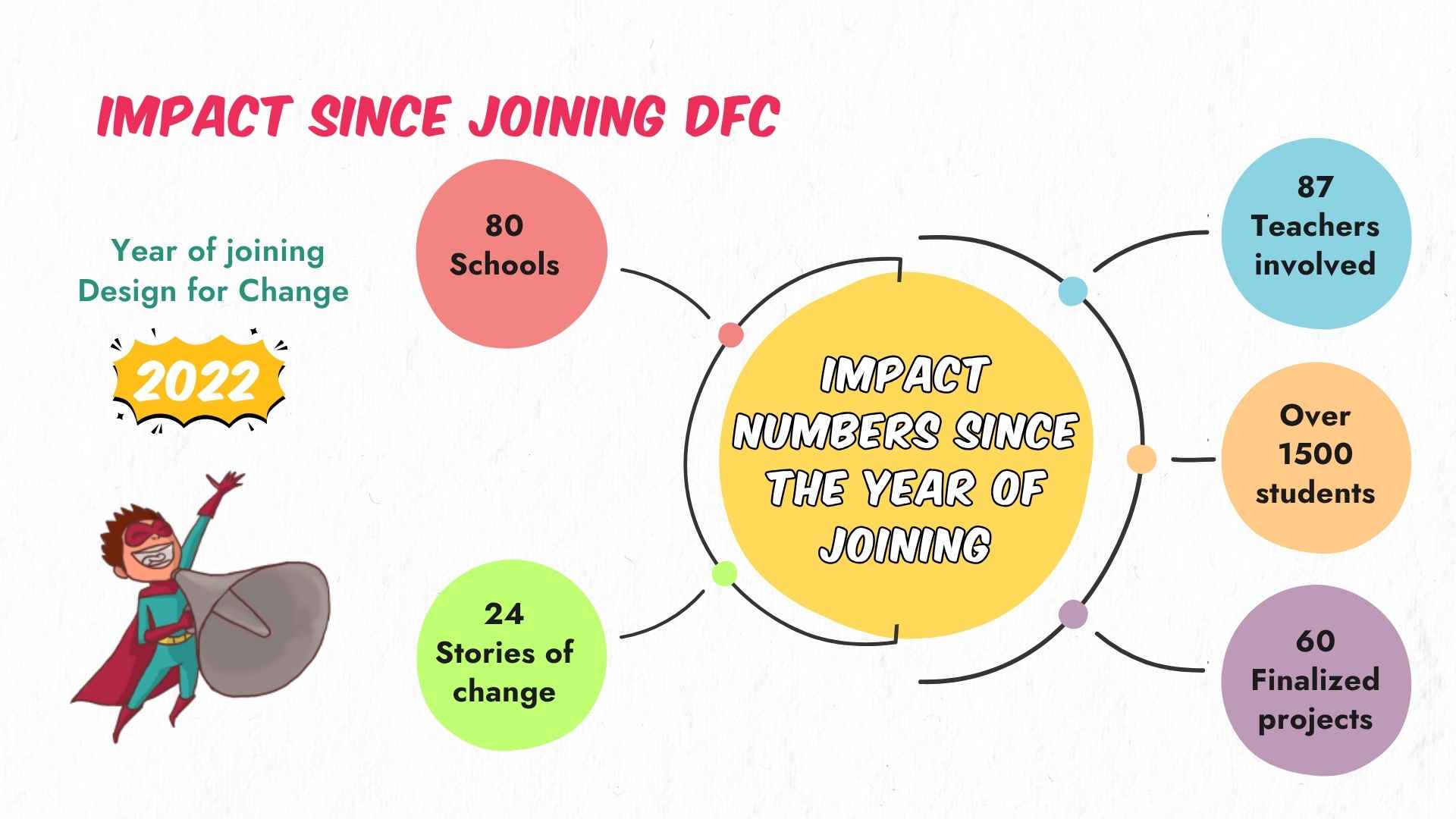
For the over 80 teachers from primary, lower secondary, and upper secondary education, as well as for the school counsellors in the Design for Change community, the value of the method became visible in the way students were engaged: not as recipients of activities, but as individuals capable of defining their own problems and acting on them.
The same idea is reflected in the experience of Ana Clara, a primary school teacher (3rd grade): “It is not about me as a teacher and what I know how to do, but about how I know to step back and allow children to participate, to make decisions, and to discuss them together. Maybe things do not change after the first project, but if you give them trust and continue, something essential begins to take shape.”
“It is a solution to a problem that we, as teachers, have been talking about for many years – the lack of student involvement in school life,” confirms Maria, a high school teacher.
Feel, Imagine, Do, Share
“Students rarely have the opportunity to take ownership of the entire process, from identifying problems to finding solutions and actually addressing them,” says Alina, a primary school teacher (3rd grade).
The methodology behind Design for Change is structured around four simple steps: Feel, Imagine, Do, and Share.
The first step, Feel, requires time and patience. Students are encouraged to observe what is happening around them, to discuss the issues that affect them, and to understand how these are experienced by others.
“I think the Feel stage is what gives this method its value compared to others. I have also implemented project-based learning or service learning projects, where we identify a problem. The difference here is the nuance of putting ourselves in others’ shoes, of seeing more clearly how others – or even we ourselves – are affected, sometimes without realising it. I believe this is what adds value to the method,” shares Paul, a teacher of psychology and pedagogy.
The next step, Imagine, is the stage where ideas are explored without being immediately filtered. Students propose, discuss, combine, and test different directions, while the teacher takes on the role of facilitator, not evaluator. This is also the stage where ideas are debated and voted on.
“We drew a map of the community and conducted interviews with the school principals. It was very important and interesting that we encouraged the children to conduct the interviews themselves. They immediately organised into teams and prepared their questions. The principals even asked me: ‘Are you sure you didn’t intervene in the questions?’ I told them I didn’t even know what questions they asked. It wasn’t my role to know. My role was only to make sure the connection existed and that they knew the children would come. From that point on, it was their responsibility,” shares Marina, school counsellor.
The third step, Do, brings the process into reality: planning, assigning responsibilities, implementation, and adjustment. This is where one of the most important lessons for students emerges: change is not linear and requires adaptation.
“After two years of Design for Change, several colleagues who teach 5th grade told me: ‘these children are made for projects’. They are independent; it’s enough to outline an idea, and they take it from there immediately. They know what they have to do, what the steps are, and how to bring an idea to completion. They have become autonomous and work very well. These are things that are not taught in any subject, but are built over time through real experiences. You can see that they were given the freedom to act, and along with that, their confidence has grown,” says Simona, an English teacher in her third year of implementing Design for Change in the classroom.
The final step, Share, is about reflection and visibility. Not only the results are presented, but also the process, the challenges, and the lessons learned. In this way, local projects are shared within a global learning community, where experiences become a source of inspiration.
A process that transforms adults as well
Despite the simplicity of the method, the shift in perspective and taking on the role of facilitator rather than coordinator can be challenging at first.
“It is the hardest part of all, because we are somehow used to coordinating, and when we give them a project, we are tempted to give them the exact steps, what tools to use. Here, we didn’t indicate any of that,” explains Alina.
In addition, Aura reflects on her own lessons and challenges: “It was also a lesson for me as a teacher, because we have this tendency to take over and to constantly refer everything back to ourselves as teachers. We often forget that they are also there in the classroom – young individuals with their own emotions, who relate differently to this school community, which includes the class, the lower secondary level, the school, the city.”
Letting go of control also means a different kind of presence. “I was tempted, I admit, to influence their decisions. But I stopped. I chose to respect what was important to them. And it turned out their idea was very good. It was a learning process for me as well,” shares Marina.
Mentorship and community play an important role in this process. “That’s where I understood that it doesn’t have to be something extraordinary or something that changes the whole world. If it changes something for them – in their classroom, their school, or their small community – that is enough. That’s where change begins,” says Paul. “Children can find their own solutions, and the solutions that satisfy them are the ones they truly need.”
For Ana Clara and Simona, the shared lesson is about not intervening, speaking less, and listening more: “simply to observe what happens when children make decisions and where those decisions lead” (Ana Clara); “because they can – children can find their own solutions, and the solutions that satisfy them are the ones they truly need. As teachers, we just need to be there to encourage them, to give them hope and confidence that they can solve the problems they themselves have identified” (Simona).
This ‘I can’ is really powerful – it becomes a life mindset: you wake up in the morning, you’re having a bad day, and you tell yourself ‘I can’, and you manage to get through certain moments. It’s more than just a project slogan
Asked what he would like colleagues who encounter Design for Change and the FIDS methodology for the first time to take away, Paul speaks about trust and openness to something new:
“this motivation to slightly change the pedagogical approach, as well as the overall atmosphere in school. Because we all fall into routines, if we haven’t already… and students don’t always help us either, with their lack of enthusiasm – for school and for extracurricular activities alike. So I think this is a good way, a good method to reactivate things, even at a very small level, however micro it may be – I believe it has this power.”
“For those who come into contact with the methodology for the first time, I would like them to become, in a way, like children themselves – leaving with the idea that they can, that they can bring this project into their classroom and inspire their students, those they interact with, and even their colleagues at school, where there is openness.
To leave with the joy of trying something new and with the confidence that it will work very well – because it will work very well, no matter how many times you implement it. It’s not difficult, there’s nothing complicated about it.
I would like them to leave with the idea that they need to take a step back and allow children to make decisions. Without trying to intervene and without trying to distort the children’s ideas. Design for Change tells you: ‘wait two seconds and listen!’ I think this is the most important message. Take two seconds and listen to what a child is saying, because maybe, and most likely, they don’t see what you see. They see something else. And even if it’s simple, that doesn’t mean it’s not valuable,” concludes Ana Clara.