Guidance and Courage: How Teenagers Discover Their Path with InnoMate
From “I don’t know what I want” to “I have a plan”: how can teachers spark change?
In Romania, more than a third of adolescents are not enrolled in any form of education. And among those who do reach high school, many are unsure of what they want to do next.
An adolescent who does not understand the purpose of school or lacks confidence in their own abilities will give vague answers when asked what they want to become. The absence of a clear plan for the future is often the first step towards dropping out.
Only 15% of high school students feel prepared for the labour market, while nearly 70% say they want a balance between personal and professional life – without knowing, however, how to achieve it.
In the absence of career counselling and real-life experiences outside the classroom, confidence erodes quickly.
Change happens when students are given autonomy, guidance and the chance to test their ideas. Career counselling and entrepreneurial education are two of the most effective tools – not only because they offer young people options, but because they also build the confidence that they can shape their own path.
An educational programme such as InnoMate – Innovation for the Future does exactly this: it supports students in technological high schools to discover their professional direction and to put their initiative into practice.
Entrepreneurship, career guidance and courage: what students discovered in InnoMate
Starting from the need to have teachers who can guide students in their educational and career choices, the intervention began with the training of school counsellors and teachers in career guidance.
The training course was complemented by InnoKit – a practical entrepreneurship curriculum developed by United Way Romania and adapted to be used by teachers in interactive sessions with students.
This became the foundation of workshops organised in four partner high schools in Bucharest, offering a structured framework where students worked in teams, turned ideas into business plans and practised critical thinking and collaboration.
From the very first activities, students analysed their interests, values and strengths, reflecting on what a healthy career choice looks like. In career counselling sessions, they explored a variety of professions and began to sketch their own career plans. In entrepreneurship workshops, they worked in teams to identify needs in their communities and came up with business ideas – from mobile apps for online safety to beauty salons or local cafés.
The next stage of the programme introduced practical experiences, showing students that some professions appear and evolve according to labour market dynamics. Still, developing certain skills early on remains essential.
This was one of the key lessons learned during job shadowing visits, where students met professionals from different fields, asked questions and directly observed the dynamics of real workplaces.
To prepare them for the moment when they will present their own business ideas, students now go through public speaking and mentoring sessions. They learn how to structure a speech, what to highlight in a pitch and how to manage their emotions in front of a jury or an audience.
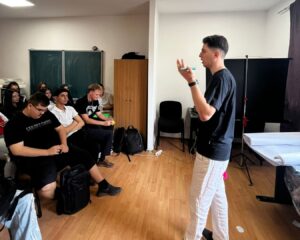
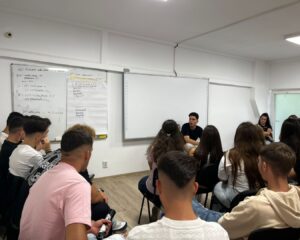
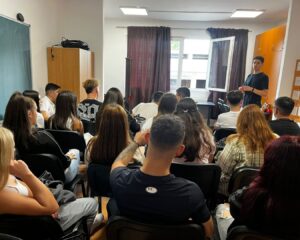
The stages of the programme were designed progressively, so that students develop life skills: from self-awareness and teamwork to entrepreneurial thinking, effective communication and active engagement in their community.
The role of career counsellors in developing metacompetencies
Metacompetencies – such as self-confidence, critical thinking, adaptability and decision-making – are essential skills that enable young people to keep learning throughout their lives, to adapt to change and to build coherent career paths.
In school, career counsellors and teachers can play a decisive role in cultivating these abilities. Not by offering ready-made answers, but by asking relevant questions, listening actively and creating contexts where students can discover themselves.
When an adolescent begins to believe in their own ideas, something changes.
In InnoMate, counsellors and teachers did not hand out recipes for success. Instead, they guided students to formulate their own questions and answers. They talked about interests, fears, courage and the future – and they learned that it is not about knowing everything from the start, but about understanding who you are and what you want to build.